How the Best Hosting Teams Are Scaling Smarter
When was the last time a client left because your product failed, and it was actually your support team that let them down?
For hosting companies, that question cuts differently than it does for most businesses. Your product and your support are not two separate things. They are the same thing. When a server goes down at 11pm, when a cPanel migration breaks mid-transfer, when a client's ecommerce site stops responding on the busiest shopping day of the year, the quality of your response in those next few minutes is your brand. Not your pricing page. Not your uptime guarantee printed in the contract. The engineers who pick up.
This is the argument the hosting industry’s best operators have quietly accepted and acted on. Your support team is your product. And if you are still treating it as a cost centre to be managed rather than a competitive advantage to be built, you are losing ground to companies that figured this out before you did. At TeamScaler, we have spent sixteen years placing and managing infrastructure engineers across hosting companies, MSPs, and cloud infrastructure providers in the US and Europe.
The Talent Problem Hiding in Plain Sight
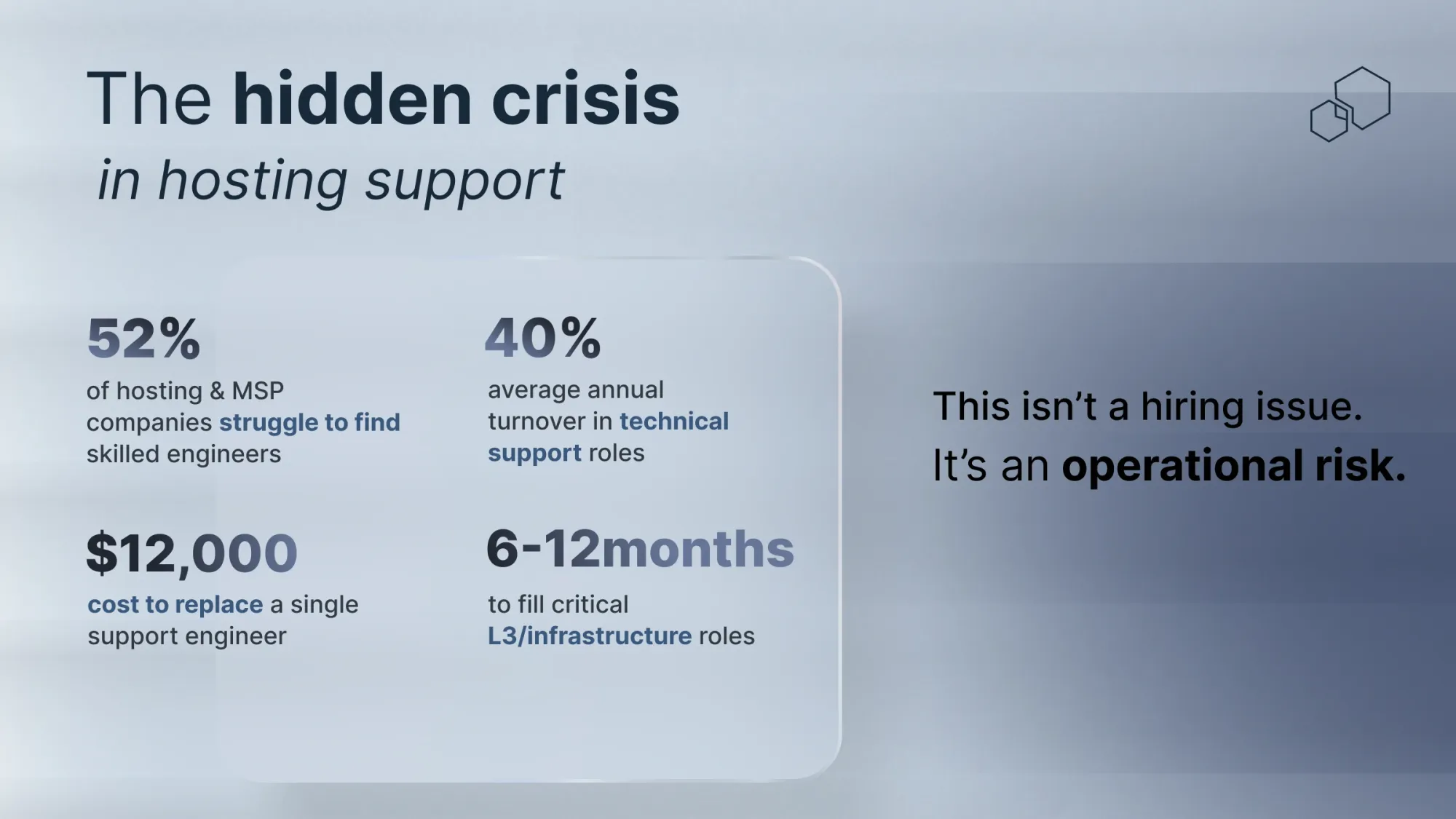
Here is a number worth sitting with. According to CompTIA's IT Industry Outlook, 52% of channel companies, including MSPs and hosting providers, report genuine difficulty finding candidates with the skills they need. That is more than half the industry quietly struggling to staff the roles that keep their clients online.
The situation is more specific than a general talent shortage. L3 engineers, NOC engineers, Linux and cPanel specialists who can handle genuine escalations rather than just close tickets, these are among the hardest roles to fill and the fastest to churn. The technical support and IT industry sees average annual turnover close to 40%. Every departure costs an MSP approximately $12,000 in direct replacement costs, before you account for lost context, disrupted client relationships, and the invisible pressure placed on the engineers still standing.
The result is a cycle most hosting companies recognize immediately. You need 24/7 coverage. You cannot find the engineers. The engineers you do find leave before they become genuinely useful. Meanwhile, clients are measuring you against an uptime standard that has no tolerance for operational chaos happening behind the scenes.
The Uptime Institute's Annual Outage Analysis 2024 found that 55% of operators experienced at least one significant outage in the past three years. Research cited by Pingdom found that larger businesses can lose over $16,000 per minute during an outage. The 99.99% uptime guarantee most hosting companies advertise allows just 52 minutes of downtime per year. Those numbers do not leave room for a gap in your coverage schedule.
When Support Fails in the Real World
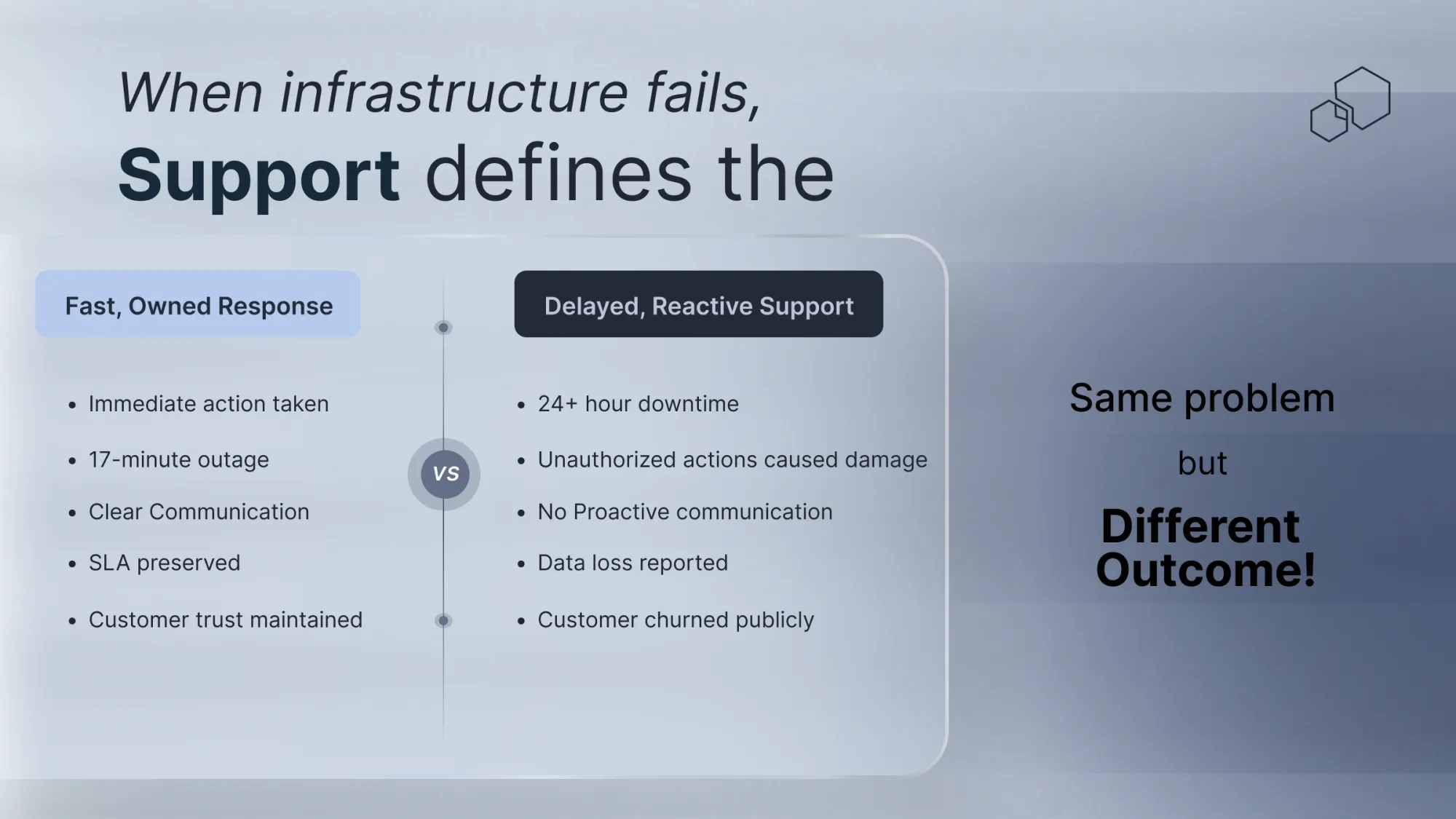
OVHcloud, October 2024. One of Europe's largest cloud hosting providers suffered a global backbone network outage lasting 17 minutes. Traffic from OVH’s network to major platforms dropped by as much as 95% at peak impact. The root cause was a network configuration pushed by a peering partner, a technical trigger, but one that exposed how quickly an infrastructure event cascades into a client-visibility crisis. OVHcloud’s engineers moved fast to reconfigure routes and restore traffic. The brevity of the outage, and the speed of the response, kept the annual SLA technically intact. But for customers whose sites went dark mid-afternoon, what mattered was not the SLA document. It was who answered, how fast, and whether they owned the problem from the moment it started.
Web Hosting Canada, August 2021. A third-party service provider used their privileged account access to initiate server reimaging on production and backup servers, without authorization. Within hours, the incident response team had locked the individual out and disaster recovery was underway. But the damage was already done. Some data was unrecoverable. And on Reddit, the story was not the breach itself. It was the support failure that followed. Customers reported that their websites and emails had been down for over 24 hours with no proactive communication from the company. “I was never informed there were any issues until I noticed emails stopped coming in,” one affected user wrote. Another simply said: “This is a massive fail. I’ll be jumping ship.” They did. The incident became a case study not in infrastructure vulnerability, but in what happens when the human response does not match the severity of the event.
These are not edge cases. They are the standard. And both illustrate the same truth: when something goes wrong, the support team is the last line between a resolved incident and a lost client.
Performed SLAs Versus Owned SLAs
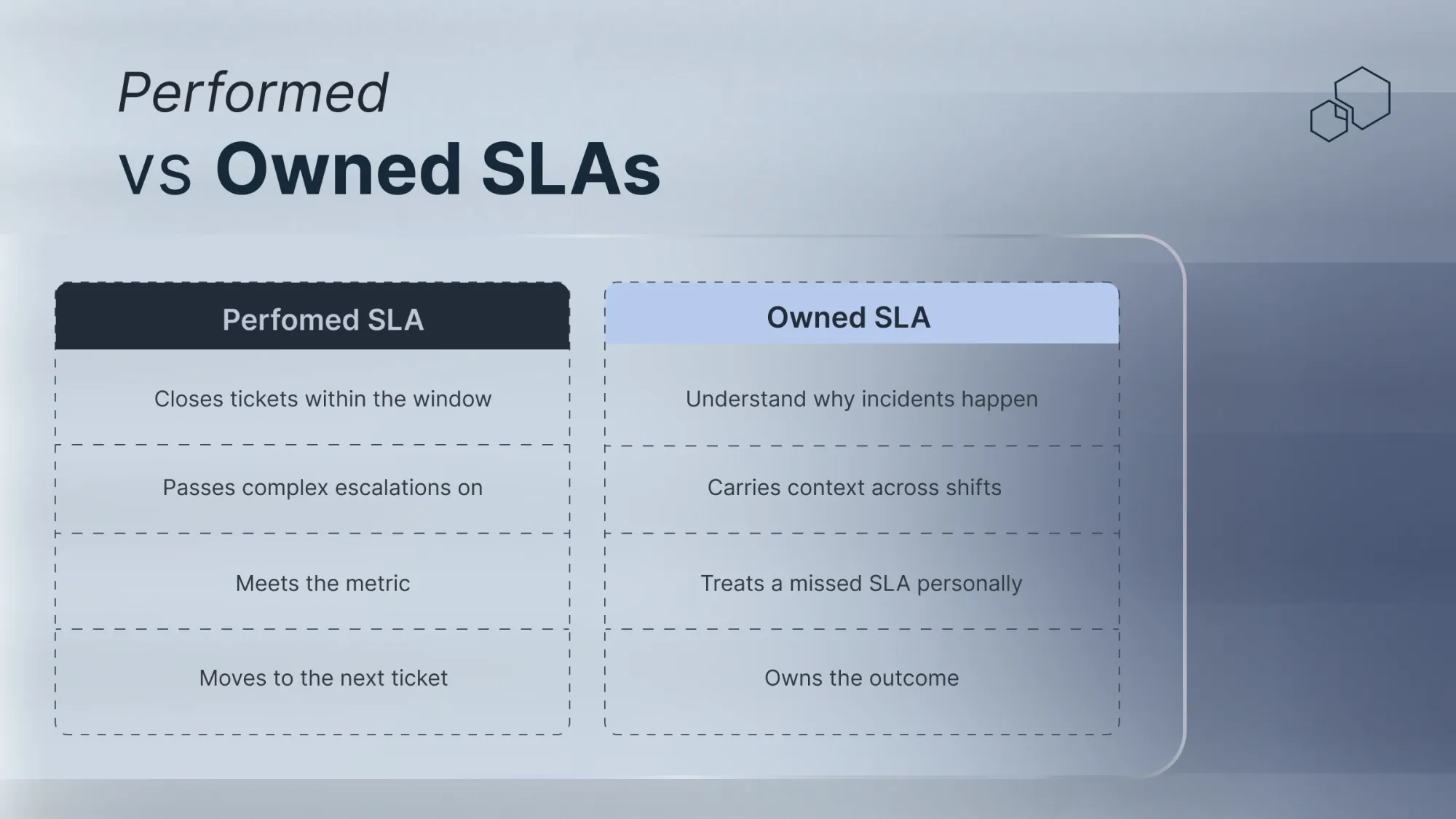
A performed SLA engineer closes tickets within the agreed window. They hit the response time metric. They move to the next ticket. On a dashboard, they look fine.
An owned SLA engineer understands why a particular client's environment behaves differently at peak load. They know which escalation paths are likely to cascade before the cascade starts. They carry context across shifts so the engineer picking up at 6am knows exactly what happened at 2am without reading a three-paragraph handoff note. And when something goes wrong, they treat it as something that happened to them personally, not as a metric that slipped.
Here is a question worth asking your current support team right now. If a client calls tomorrow and asks what happened on their account last Tuesday night, can your L3 engineer answer without looking it up? If the answer is no, you have a performed SLA operation. If the answer is yes, you have something worth protecting.
The HappySignals 2025 Global IT Experience Benchmark Report found that every time a support ticket is reassigned 9rather than owned end to end, end-user satisfaction drops by eight points and users lose an average of two more hours of productive time. In a hosting environment where a single client may have dozens of sites and hundreds of their own customers depending on uptime, that compounds fast.
The Growth Trap, and the Smarter Path Out
There is a specific kind of exhaustion that comes with trying to scale a hosting operation the traditional way. Every new client brings new coverage requirements. The traditional response is to hire, which means six to twelve months of recruiting for a role that requires very specific skills in a talent pool that is genuinely shrinking, followed by onboarding, training, hoping they stay long enough to become useful, and repeating when they do not.
According to MSP staffing research published in 2025, the average MSP has been trying to fill critical infrastructure support positions for six to twelve months at a time. That is not a hiring delay. That is a strategic gap compounding every month it goes unfilled.
The smarter path is to decouple the scaling of your operations from the scaling of your overhead. Firms using embedded infrastructure engineering partnerships reported a 27% decrease in system downtime and a 19% reduction in operational costs in 2024, according to Precedence Research's managed services market data. That combination does not happen by accident. It happens when coverage gaps close and the engineers filling them are vetted specifically for infrastructure operations, not generalist IT support.
At TeamScaler, we place engineers into hosting and MSP operations teams within three days of a confirmed requirement. Every engineer has passed a rigorous technical and operational vetting process. Only the top 3% of candidates reach a client shortlist. That standard exists because in infrastructure support, the difference between a good engineer and the wrong engineer is not just a performance metric. It is the 3am incident that either gets resolved cleanly or becomes a client conversation you did not want to have.
The Certification Question Your Enterprise Clients Are Already Asking
Enterprise clients and businesses operating under compliance frameworks do not just evaluate your uptime record. They evaluate your security posture. IBM’s Cost of a Data Breach Report 2024 put the average breach cost at $4.88 million. The Verizon 2025 Data Breach Investigations Report found that approximately 60% of breaches involved a human element, and in infrastructure support, that human element is your L3 engineers. The ones handling credentials at 2am. The ones with access to server configurations during a migration.
SOC 2, ISO 27001:2022, and GDPR compliance are not marketing badges. They are the frameworks that determine whether your enterprise clients can sign off on the engineers keeping their infrastructure live. When your support team operates to these standards as a baseline, you are removing the procurement friction that slows down your largest deals. Backed by sixteen years of delivery through Nuventure Connect, TeamScaler engineers carry these certifications as a standard of operation, not an optional extra.
The Only Metric That Eventually Tells the Whole Story
In hosting, uptime is not something you achieve once. It is something you defend every single hour. Over 68% of global enterprises outsourced at least one component of their operations to managed partners in 2024, with 24/7 support being the most in-demand service. The companies at the top of the hosting market have already resolved this question.
The operators that will define the next decade of hosting are not the ones with the most servers or the lowest prices. They are the ones who understood that their support team was their product and built it accordingly.
Ready to close the coverage gaps with infrastructure engineers who work from inside your operations? Start your conversation with us.