Why Hosting Companies Hire Offshore Linux Administrators in the AI Era

It's 2:47 a.m. Eastern. A CloudLinux node carrying 800 cPanel accounts hits a load average of 140. A compromised WordPress plugin is pushing spam through Exim, the mail queue is at 60,000 and climbing, and the server's IP has just been listed on Spamhaus. By 8 a.m. you'll have a pile of reseller tickets, a blocklisted subnet and SLA credits to issue.
The question every VP of Operations at a hosting company eventually faces isn't whether this happens. It's who is awake, qualified and authorised to fix it in the first 15 minutes.
For a growing number of North American hosts, the answer is an offshore Linux system administrator, embedded in their team and working a normal daytime shift while the US sleeps. Here is the operational case for it.
The staffing math behind 24/7 Linux server support
Covering one seat around the clock means covering 168 hours a week. At 40 hours per engineer, that's 4.2 FTEs. Add PTO, holidays, sick days and training, and you need about five engineers to keep one qualified person on shift at all times.
In-house, that means five senior Linux salaries, benefits, night-shift differentials and the attrition that follows graveyard rotations. Most mid-sized hosts compromise instead. They staff L1 and L2 overnight, keep L3 on a pager and hope the pager isn't needed.
The offshore model changes the economics. Engineers in India work US nights as their normal day, so there's no fatigue penalty and no graveyard turnover. With dedicated engineers starting at $2,000/month, a five-person rotation costs about $120,000 a year. That is roughly what one senior in-house hire costs fully loaded.
What is the difference between L2, L3 and L4 support?
L2 support fixes known problems with documented runbooks. L3 support diagnoses problems nobody has written a runbook for. L4 support handles failures in the platform itself, such as storage, network or vendor software. In a hosting environment, it looks like this:
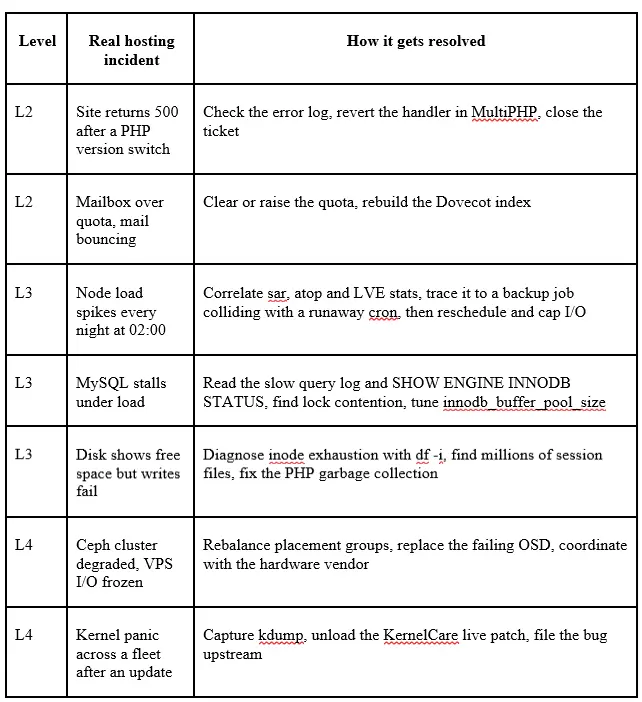
Where the escalation chain usually breaks: most hosts have L2 coverage at night but keep L3 on daytime hours. Anything a runbook doesn't cover waits six to eight hours. That gap is what managed L3 support engineers on a follow-the-sun shift close, and it is where most of your MTTR (mean time to recovery) and churn risk sits.
What AI changed in hosting ops, and what it didn't
AI has made L3 talent more valuable, not less. Four shifts explain why:
- Your ticket mix got harder. AI chatbots and knowledge-base deflection now handle password resets and "how do I point my domain" questions. The tickets that reach a human are the ones that need real diagnosis.
- AI crawlers became a load problem. Aggressive LLM scrapers now hammer shared servers and WordPress sites. Fixing it takes rate limiting at the LiteSpeed or Nginx layer, ModSecurity rules and per-account LVE limits, which is L3 work.
- AI-generated scripts need a reviewer. An LLM will write you a cleanup script with find / -mtime +30 -delete. Someone who understands what that does on a server with 800 tenants has to check it before it runs.
- GPU hosting is a new product line. Inference servers bring NVIDIA driver and CUDA version pinning, the NVIDIA Container Toolkit, MIG partitioning and thermal monitoring. These are new Linux skills your current team may not have.
AIOps tools can flag an anomaly in Prometheus. They can't yet decide, at 3 a.m., whether to fail over a database primary that 2,000 customer sites depend on.
Certifications that predict performance on a hosting floor
A certificate won't fix your Exim queue on its own. But performance-based exams are a reliable first filter when you hire across borders. Map each one to the incidents you actually see:
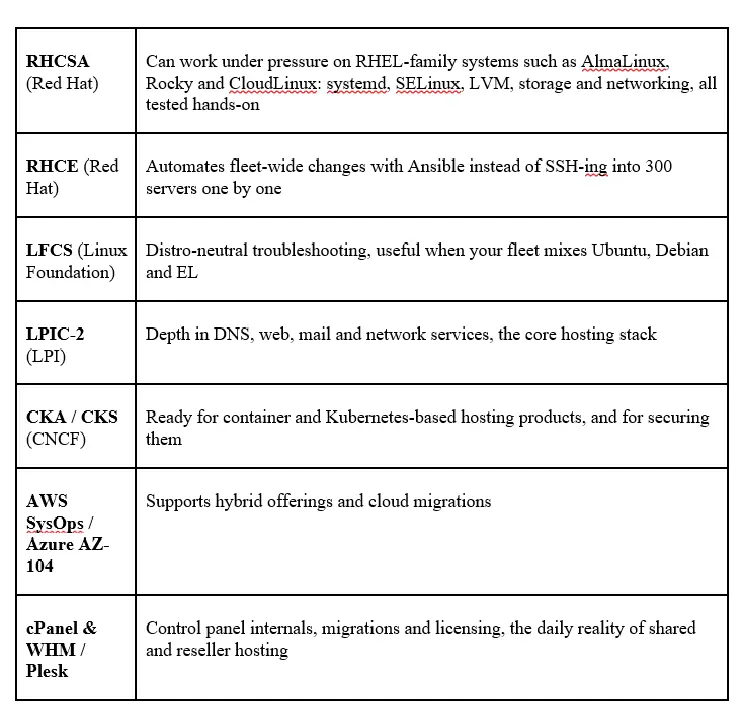
Check the vendor too. If engineers will hold root on your fleet, the provider's ISO 27001 and SOC 2 attestations keep your own audits clean.
Before you hire an offshore Linux system administrator: five things to insist on
- A real access model. Bastion hosts, per-engineer SSH keys or certificates, MFA, sudo scoped by role and full session logging. No shared root passwords, ever.
- Embedded, named engineers. They should work in your Jira, Zendesk or WHMCS queue, follow your runbooks and sit in your Slack incident channels. A ticket-forwarding helpdesk doesn't qualify.
- Structured shift handovers. Written handoffs covering open incidents, pending changes and watch items, so context isn't lost every eight hours.
- Owned SLAs. Commitments on time to engage and time to resolve, not just time to acknowledge.
- You pick the engineers. Interview candidates against your own stack. Test them on a real past incident, not trivia.
Solve the 3 a.m. problem in 72 hours
TeamScaler embeds dedicated L3 and L4 Linux engineers, SREs and NOC teams directly in hosting companies and MSPs. That includes cPanel/WHM, Plesk and bare-metal specialists. You interview them and choose them. They work in your tools and own your SLAs, backed by ISO 27001 and SOC 2 certified operations and 16 years of delivery through Nuventure.
Dedicated engineers start at $2,000/month, and your first covered shift can be three days away.