Can Your Team Recover etcd When Your Kubernetes Cluster Goes Down?
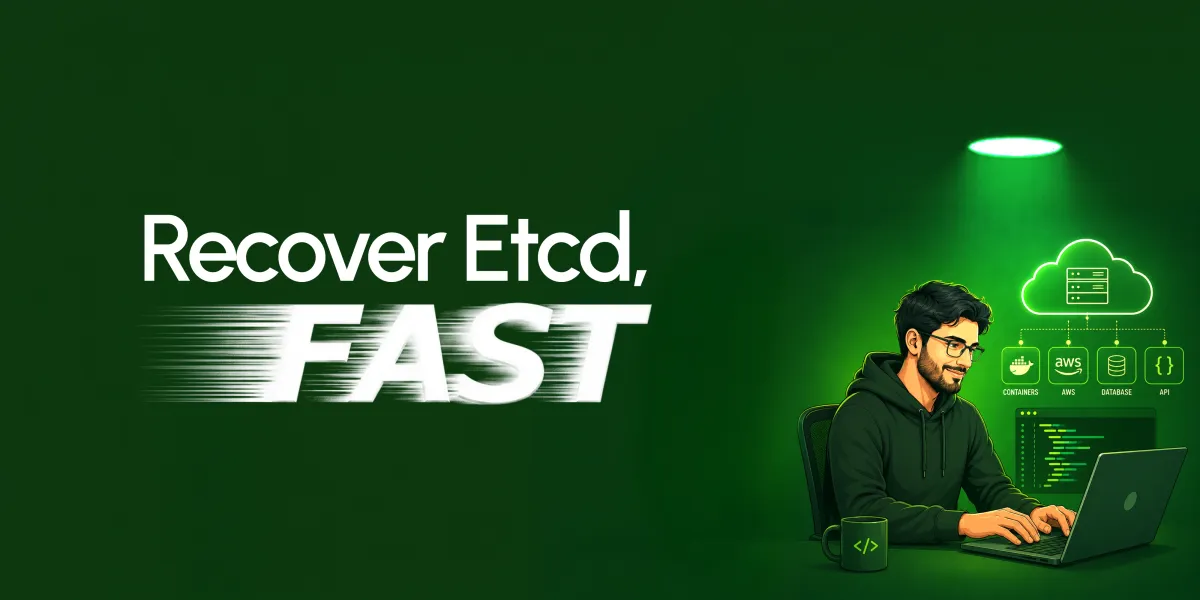
It was 2:17am when the alerts started firing.
A SaaS platform serving enterprise customers across three continents watched its Kubernetes cluster go dark. Not a pod failure. Not a node crash. The entire control plane had stopped responding. Kubectl commands hung. New deployments froze mid-rollout. Customer dashboards went blank. In the war room, nobody could answer the one question that mattered: what exactly had failed, and how do we bring it back?
The answer, when they found it four hours later, was three words long: etcd had failed.
This is not a rare story. At TeamScaler, our Scale to Run engineers have seen this pattern more times than we can count: organizations running sophisticated Kubernetes environments at scale, with mature CI/CD pipelines, production-grade observability stacks, and experienced platform teams, who have never once had a documented conversation about etcd. Until it breaks.
What etcd Actually Is, and Why Everything Depends on It
etcd is the distributed key-value store at the core of every Kubernetes cluster. It is where Kubernetes writes and reads everything it knows: cluster configuration, node state, pod scheduling decisions, secrets, ConfigMaps, service endpoints, RBAC policies. Every time you run kubectl apply, kubectl get, or kubectl delete, the Kubernetes API server is either writing to or reading from etcd.
Think of it as the brain’s long-term memory. The control plane, the scheduler, the API server, they are all processing units. But etcd is where the state lives. And unlike most components in a Kubernetes environment, etcd does not degrade gracefully. When it struggles, everything struggles. When it fails, the cluster effectively ceases to function as an orchestration platform. New pods will not schedule. Running workloads may continue briefly, but you have lost the ability to manage, scale, or recover anything.
The reason most Kubernetes support teams are unprepared for etcd failures is precisely because etcd is invisible when it works. It sits quietly, processing thousands of writes per minute, maintaining consensus across its cluster members, and asking for nothing in return except attention that most teams never give it.
The Four Ways etcd Quietly Builds Toward a Crisis
etcd does not usually fail without warning. It fails because nobody was watching the warnings. Here is what those warnings look like in production environments.
Database size growth without compaction
etcd retains a full revision history of every key it stores. In active clusters, especially those running frequent deployments, HPA scaling events, or high-volume CI/CD pipelines, the etcd database grows continuously. Without periodic compaction to prune old revisions and defragmentation to reclaim disk space, the database will eventually hit its size quota. At that point, etcd transitions to a read-only state. The cluster appears alive but is functionally paralysed.
Quorum loss from silent node failure
etcd relies on the Raft consensus algorithm, which requires a majority of members, a quorum, to agree before any write is committed. A three-member etcd cluster can tolerate one failure. A five-member cluster can tolerate two. Lose one node quietly, without automated remediation or alerting, and you are one more failure away from a cluster that cannot accept any writes at all. Most managed Kubernetes environments have no dedicated alert for etcd member loss.
Slow disk I/O degrading heartbeat performance
etcd is extremely sensitive to disk latency. It measures commit latency in milliseconds, and high-latency storage, common in cloud environments where disk IOPS are not specifically provisioned for control plane workloads, causes heartbeat timeouts between members. This leads to frequent leader elections, which degrade API server responsiveness and create cascading delays across the entire cluster. The symptom looks like a slow cluster. The cause is a disk problem that only an engineer with etcd-specific expertise will diagnose correctly.
Unplanned version upgrades breaking data compatibility
Kubernetes upgrade cycles pull etcd versions along with them. A cluster upgrade that is not carefully sequenced can leave etcd in a state where the data schema version does not match the binary version. In environments where Kubernetes managed support engineers are expected to handle both cluster upgrades and operational stability, this is a recurring source of post-upgrade incidents that take hours to diagnose because the failure mode looks deceptively similar to other control plane issues.
What a Mature etcd Operations Practice Actually Looks Like
Organizations that run Kubernetes in production at scale without etcd incidents do not have better luck. They have better operational discipline. The difference, consistently, comes down to five practices.
Dedicated etcd monitoring. This means specific Prometheus metrics for etcd database size, compaction duration, peer round-trip time, leader election frequency, and fsync latency. Not generic node metrics. Not cluster-level health checks. etcd-specific instrumentation with alerts tuned to fire before the database hits critical thresholds, not after.
Automated compaction and defragmentation. Compaction should run on a scheduled basis, typically every hour in active clusters, to prune revision history and keep the database size within safe operating bounds. Defragmentation should follow compaction to reclaim the freed disk space. Both operations need to be scripted, automated, and monitored for completion. Manual compaction is an operational debt that compounds silently.
Tested backup and recovery runbooks. etcd snapshots should be taken continuously and stored outside the cluster, in a separate storage account or object store with versioning enabled. The critical word here is tested. A backup that has never been restored is not a backup; it is a guess. Mature Kubernetes operations teams practice etcd restore procedures in non-production environments on a regular cadence so that the first time an engineer performs a restore under pressure is not actually the first time.
Upgrade sequencing discipline. Every Kubernetes version upgrade should include an explicit etcd compatibility check, a pre-upgrade snapshot, and a post-upgrade validation of etcd health metrics before any workloads are scaled or restarted. This sounds obvious. It is skipped more often than not, particularly in environments where Kubernetes infrastructure support is owned by a team that inherited the cluster rather than built it.
Quorum health as a first-class alert. An alert that fires when any etcd member becomes unreachable should be treated with the same urgency as a node failure. In practice, the loss of one etcd member in a three-node cluster should trigger immediate remediation, not a next-business-day ticket.
The Harder Truth About Kubernetes Operational Depth
When companies look to hire Kubernetes engineers or build out managed Kubernetes support capacity, the job descriptions almost always focus on the build side: cluster provisioning, Helm chart authoring, CI/CD pipeline integration, service mesh configuration. etcd operational expertise is rarely listed as a requirement, and almost never tested in interviews.
This creates a predictable gap. Companies running Kubernetes in production for customer-facing workloads discover, usually during an incident, that their team knows how to build on Kubernetes but does not know how to recover it. The knowledge required to perform an etcd restore from a snapshot, re-establish quorum after member loss, or diagnose disk I/O issues causing leader election instability is not the kind of knowledge that appears in a bootcamp curriculum or a platform engineering onboarding doc. It comes from operational experience running production Kubernetes clusters under failure conditions.
This is the distinction between a Kubernetes DevOps engineer and a Kubernetes L3/L4 support engineer. The former builds and deploys. The latter owns what happens at 2am when the build is live and something the architecture never anticipated begins to fail at the infrastructure layer.
For hosting companies, MSPs, and SaaS platforms operating multi-tenant Kubernetes environments, this gap is not a minor inconvenience. It is a direct liability on customer SLAs, a churn risk, and a reputation problem that compounds with every unresolved escalation.
Operational Depth Is Not a Nice-to-Have
The SaaS platform from the opening of this piece recovered. It took four hours, one escalation to a specialist with etcd restore experience, and a post-mortem that revealed the database had been growing unchecked for six months. A compaction schedule had never been set up. Backups existed but had never been tested. There was no runbook.
The cost was not just four hours of downtime. It was the customer conversations that followed. The SLA credits. The trust that takes months to rebuild once enterprise customers have experienced an unexplained, hours-long outage with no clear communication during the incident.
At TeamScaler, the Scale to Run engineers we embed into hosting companies, MSPs, and SaaS platforms bring this operational depth as a baseline. They arrive with etcd monitoring configured, compaction automated, backup schedules in place, and recovery runbooks documented before the first incident ticket is ever opened. That is not because we are cautious. It is because we have seen what happens when these foundations are missing, and we have learned to build them first.
Kubernetes managed support is not about keeping the lights on. It is about knowing exactly which circuit to check before the lights go out. etcd is that circuit. It deserves to be treated like it.
If your team runs Kubernetes in production and you are not confident about your etcd health, backup, or recovery posture, that is a conversation worth having before an incident forces it. Talk to TeamScaler.