The L2 and L3 Support Gap No One Talks About
Every hosting company, MSP, and SaaS platform has a support structure. Tickets come in, engineers respond, issues get resolved. On paper, the system works. In practice, the line between what L2 support handles and what genuinely requires L3 expertise is blurred far more often than most operations leaders would care to admit, and that blur has a cost that rarely shows up on a dashboard until it is too late.
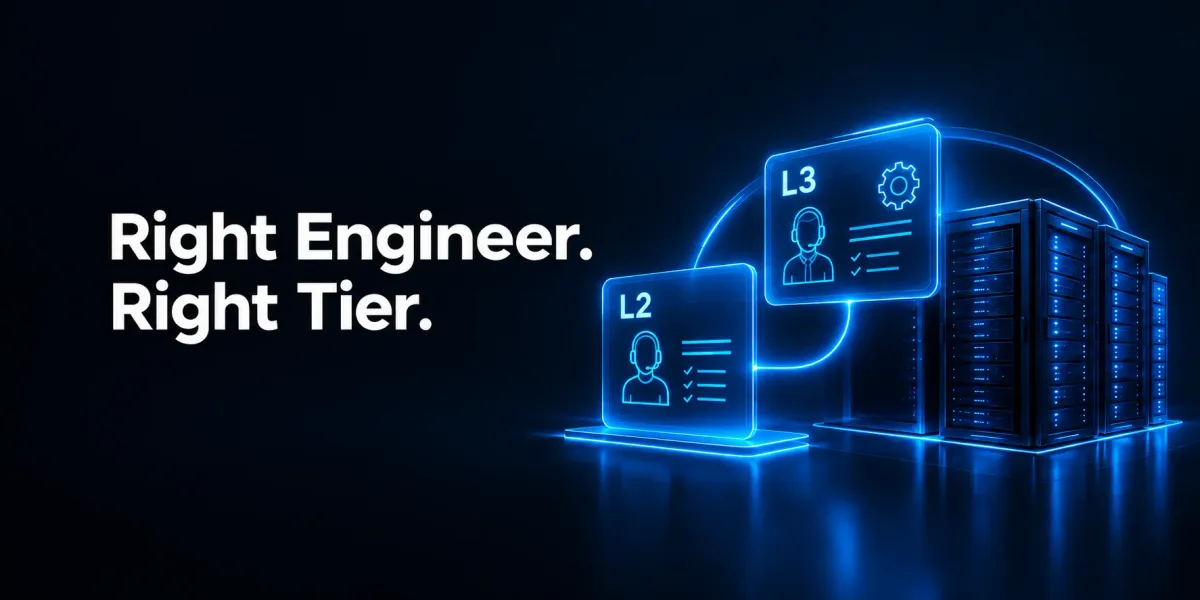
Understanding where L2 ends and L3 begins is not just an operational nicety. For companies running critical infrastructure, it is the difference between a minor incident and a major outage. TeamScaler's service is built around exactly this distinction, placing experienced L3 and L4 managed support engineers for hosting companies, MSPs, and SaaS platforms who know not just how to respond to incidents, but how to own them.
What L2 Support Actually Does
L2 support is where most companies feel comfortable. It handles escalations from L1, resolves known issues using documented procedures, performs routine diagnostics, and manages standard configuration changes. For a hosting company, L2 might mean resolving a cPanel login issue, restarting a service, or walking a client through a DNS misconfiguration.
L2 engineers are competent, trained, and essential. But their effectiveness depends entirely on the problem being one that has been seen before and documented. The moment an incident steps outside that boundary, an unfamiliar kernel error, an unexpected database behaviour under load, a cascading failure across interdependent services, L2 is no longer the right resource. The problem needs L3.
What L3 Support Actually Requires
L3 support is a fundamentally different discipline. Where L2 follows documented resolution paths, L3 engineers build them. They diagnose problems that have no precedent in the runbook, work directly at the infrastructure level, and make decisions that have immediate consequences for production environments.
A genuine L3 engineer for a hosting environment understands not just how to restart Apache. They understand why Apache is behaving unexpectedly under a specific traffic pattern, what the underlying resource contention looks like at the kernel level, and how to resolve it without triggering a secondary failure in the process.
Human error remains one of the leading contributors to major data centre and infrastructure outages, and a significant portion of those errors occur during incident response, when the wrong tier of engineer is attempting to resolve a problem beyond their verified expertise. The cost of those errors compounds quickly.
The distinction matters because L3 expertise is not simply L2 with more experience. It requires deep specialization in specific platforms, certified knowledge of the infrastructure stack, and the kind of production experience that only comes from having resolved complex, high-stakes incidents under real operational pressure.
The Story Behind the Outage Nobody Planned For
Consider a mid-sized managed hosting provider running several hundred client websites on a shared infrastructure environment. Their support team is experienced, well-organised, and fast. L1 handles routine tickets. L2 manages escalations confidently. For eighteen months, the system works.
Then, during a peak traffic period, a memory leak in a third-party application begins affecting shared server resources. The symptoms are unusual, intermittent, affecting only a subset of accounts, and inconsistent enough that initial diagnostics point in multiple directions. L2 begins working the problem. An hour passes. Then two. Client sites are degrading. SLA clocks are running.
The issue is not that the L2 team was incompetent. The issue is that the problem required kernel-level diagnosis, live memory profiling, and a decision to isolate affected accounts in a way that required deep platform knowledge to execute without causing further disruption. That is L3 work. And in this scenario, the company did not have L3 on call.
This scenario is not unusual. A 2022 study published in the IEEE Transactions on Network and Service Management found that incident misclassification, routing a problem to an engineer without the required expertise, significantly increases mean time to resolution and is a primary driver of SLA breaches in managed service environments. The study noted that the gap between required and available expertise during an incident is one of the most preventable causes of extended downtime.
Why the Confusion Happens and Why it Persists
The L2 and L3 blur does not happen because operations leaders are careless. It happens because building a fully staffed L3 team is genuinely difficult. L3 engineers with deep platform expertise in Kubernetes, cPanel, cloud infrastructure, database systems, or network architecture are among the hardest profiles to recruit, the most expensive to retain, and the most likely to be poached by larger organizations offering more competitive packages.
For MSPs and hosting companies operating at growth stage, the economics rarely support hiring multiple senior L3 engineers across every required discipline, maintaining their certifications, and keeping them available across a 24/7 operational window. So, organizations make do. L2 engineers take on problems that sit at the edge of their capability. Runbooks get stretched beyond their intended scope. And the gap between what the support structure can handle and what the infrastructure actually requires quietly widens until an incident makes it visible.
This is precisely why L3 support engineers outsourcing has become a strategic decision for forward-thinking MSPs and hosting providers, rather than a last resort. The question is no longer whether you can afford to extend your L3 capability externally. It is whether you can afford not to.
What Strong L3 Coverage Actually Looks Like
Strong L3 coverage for a hosting or MSP environment has several non-negotiable characteristics.
First, it requires engineers with verified expertise across the specific platforms the infrastructure depends on. Not general Linux administrators, but engineers with deep, certified knowledge of the stack in production. A 24/7 NOC engineer for an MSP environment needs to understand not just monitoring tools, but the infrastructure they are monitoring and the failure modes specific to that environment.
Second, it requires genuine availability. L3 expertise that is only accessible during business hours is not L3 coverage. It is L3 on a schedule, which is an entirely different and far less useful thing when a production incident fires at 2am.
Third, it requires clear escalation boundaries. The most effective support structures define precisely what L2 handles, what triggers an L3 escalation, and what the response time commitment is at each level. Without that clarity, the blur returns and with it, the risk.
Research published in the Journal of Network and Systems Management consistently identifies escalation clarity and expertise matching as two of the strongest predictors of incident resolution speed in managed service environments. Organizations that invest in defining those boundaries and staffing to them consistently outperform those that rely on generalized support teams to self-organize under pressure.
The Resolution
The good news is that the gap between L2 and L3 capability does not have to be filled entirely by internal hiring. For hosting companies, MSPs, and SaaS platforms that need deep L3 and L4 expertise available around the clock, the most effective path is embedding experienced engineers directly into the existing support structure. Engineers who integrate with the team, understand the environment, and own escalations rather than simply receiving them.
That is the model TeamScaler's Scale to Run service is built on. Not a help desk. Not a generic outsourced NOC. Experienced, certified managed support engineers for hosting companies and MSPs who work inside your operational environment, across your support hours, at the level of expertise your infrastructure actually requires.
If your support structure is quietly asking L2 to do L3 work, the cost is already there. You just may not have seen it yet.
Ready to close the gap in your support coverage? Talk to TeamScaler today.