How Predictive Operations Are Replacing Reactive Infrastructure Management
What if the biggest obstacle to faster product delivery isn't your development process, but the way your infrastructure operates?
Behind every successful software product is infrastructure that can scale, adapt, and recover without disrupting customer experiences. As cloud native architectures, microservices, and distributed applications become increasingly complex, engineering teams are no longer challenged by a lack of operational data. Instead, the real challenge is identifying meaningful signals early enough to prevent service disruptions before they affect customers, delay releases, or consume valuable engineering time.
Every infrastructure decision directly influences software delivery, release velocity, and customer experience. As engineering teams manage increasingly distributed cloud environments, responding to incidents after they occur is no longer enough. Leading software organizations are shifting toward operational models that help engineers identify risks earlier, reduce deployment disruptions, and maintain delivery momentum without compromising innovation.
As organizations embrace this shift, many are also rethinking how they build and scale modern product engineering teams. Increasingly, they are partnering with TeamScaler to strengthen their DevOps, Platform Engineering, and AI enabled software development capabilities. By extending internal teams with experienced engineers, organizations can adopt more proactive operational practices while continuing to deliver high quality software at scale.
This shift is driving the adoption of Predictive Operations, an approach that combines artificial intelligence, observability, automation, and predictive analytics to identify infrastructure risks before they become incidents. Rather than responding to problems after they impact production, engineering teams can anticipate potential failures, improve infrastructure reliability, and deliver software faster with greater confidence.
Why Reactive Infrastructure Management Is No Longer Enough
The way software is built has changed dramatically over the past decade, but many infrastructure management practices have not evolved at the same pace.
Today's applications rarely run on a single server or within a single cloud environment. Instead, they span microservices, containers, APIs, databases, and third party platforms that continuously generate telemetry data. While this architecture improves scalability and flexibility, it also increases operational complexity.
Traditional infrastructure management focuses on detecting issues after predefined thresholds have been exceeded. High CPU utilization, memory spikes, failed deployments, or network latency trigger alerts that engineers must investigate manually. As cloud environments become more distributed and dynamic, this reactive approach makes it increasingly difficult to identify and resolve issues before they affect software delivery and customer experience.
Several factors contribute to this challenge:
- Growing infrastructure complexity: Cloud native applications generate significantly more operational data, making meaningful signals harder to identify.
- Alert fatigue: Large volumes of infrastructure alerts make it easier for critical issues to be overlooked.
- Business impact: Service disruptions delay software delivery, reduce customer trust, and increase operational costs.
Consider a SaaS platform preparing for a major product release. Infrastructure dashboards may still report healthy CPU utilization and application availability, while subtle increases in database latency, API response times, and queue processing delays begin to emerge. Viewed independently, these signals appear harmless. An AI-driven predictive operations platform can correlate them as early indicators of a potential production issue, enabling engineers to resolve the underlying bottleneck before customers experience service degradation.
This growing complexity is reflected across the industry. The CNCF Annual Cloud Native Survey 2024 shows continued growth in Kubernetes adoption, reinforcing how cloud native environments are becoming larger and more distributed. As infrastructure scales, operational visibility alone is no longer enough to ensure reliability.
Google's Site Reliability Engineering (SRE) principles similarly emphasize automation and proactive operational practices as the foundation of reliable systems.
For engineering leaders, the challenge is no longer collecting infrastructure data but transforming it into actionable intelligence before minor anomalies become production incidents. This shift toward proactive decision making is accelerating the adoption of predictive operations.
What Are Predictive Operations?
Predictive Operations is an operational approach that uses artificial intelligence, machine learning, observability, automation, and predictive analytics to identify infrastructure risks before they impact applications or users.
Unlike traditional monitoring, which reports issues after they occur, Predictive Operations continuously analyze operational patterns to forecast potential issues, recommend corrective actions, and support faster engineering decisions.
At its core, Predictive Operations combines several complementary capabilities:
- Observability captures metrics, logs, traces, and application telemetry to provide visibility across distributed systems
- Artificial intelligence and machine learning identify patterns, anomalies, and emerging risks that are difficult to detect through manual analysis.
- Predictive analytics forecasts future infrastructure behavior using historical and real time operational data.
- Infrastructure automation executes routine operational workflows with minimal manual intervention.
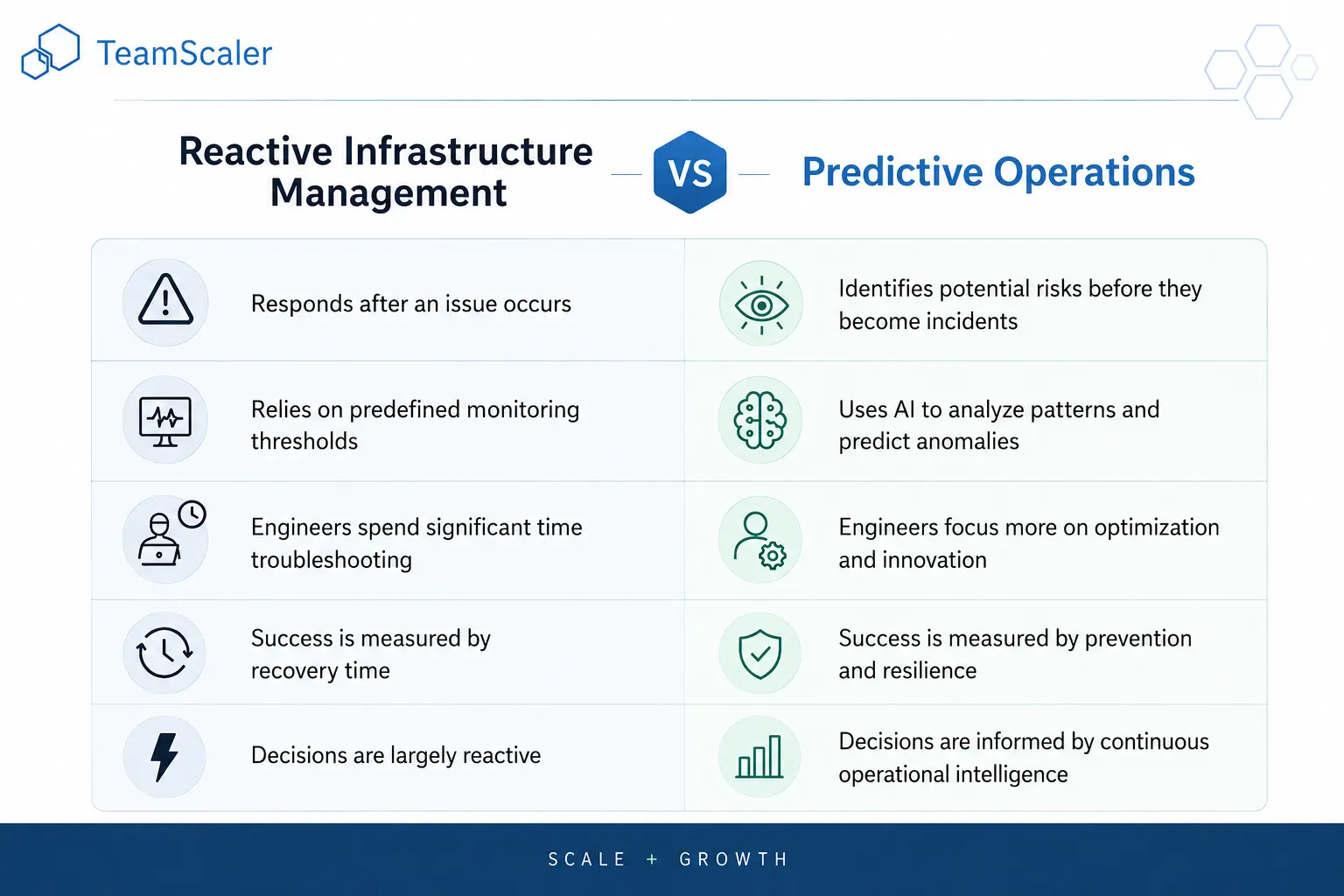
The difference is not just technological. Reactive infrastructure management focuses on recovering from failures, while Predictive Operations focuses on preventing them before they affect users or business operations.
As software systems continue to grow in scale and complexity, this shift allows engineering teams to spend less time firefighting and more time improving product reliability, accelerating software delivery, and driving long term business growth.
Five Ways Predictive Operations Are Transforming Infrastructure Management
Modern infrastructure generates millions of operational signals every day. The real value of Predictive Operations lies in turning operational data into actionable intelligence that improves software delivery and infrastructure resilience. Here are five ways it is transforming modern infrastructure management.
AI Detects Infrastructure Risks Before They Become Incidents
Production incidents rarely occur without warning. Gradual increases in memory usage, unusual database latency, or recurring deployment anomalies may appear insignificant individually but can collectively indicate an emerging infrastructure risk.
Traditional monitoring systems often detect these issues only after predefined thresholds have been exceeded. By that stage, customers may already be experiencing degraded performance.
Predictive operations use AI and machine learning to continuously evaluate operational data, recognize unusual patterns, and identify risks earlier in the incident lifecycle. Instead of reacting to alerts, engineering teams receive contextual insights that help them investigate and resolve potential issues before they affect production.
For product development companies, early risk detection reduces deployment failures and rollback events, allowing engineering teams to spend more time delivering new capabilities instead of responding to production incidents.
Intelligent Automation Reduces Alert Fatigue
Imagine an engineering team responsible for hundreds of cloud services across multiple environments. Every deployment, infrastructure change, and workload spike generates alerts, making it difficult to distinguish critical issues from routine notifications.
Predictive operations reduce this operational noise by combining AI with automation. Rather than treating every notification as a separate incident, AI evaluates historical trends, service dependencies, and operational context to prioritize alerts based on their potential impact.
Automation further streamlines operations by handling repetitive tasks such as:
- Classifying incidents based on severity.
- Correlating related alerts into a single event.
- Triggering predefined remediation workflows.
- Providing engineers with relevant diagnostic information.
Real Time Infrastructure Intelligence Improves Decision Making
Engineering leaders make decisions every day that affect application performance, release velocity, and customer experience. These decisions are only as effective as the operational insight available to them.
Predictive operations move beyond static dashboards by combining observability data with AI driven analysis to create a continuous understanding of infrastructure health.
Instead of asking, "What happened?", engineering teams can answer more strategic questions:
- Which services are showing early signs of instability?
- Which deployment introduces the highest operational risk?
- Where should engineering resources be prioritized?
- Which infrastructure changes are likely to affect application performance?
This level of operational intelligence supports faster, evidence based decisions across the software delivery lifecycle.
Engineering teams can make faster, evidence based decisions before infrastructure issues affect software delivery.
Predictive Capacity Planning Optimizes Cloud Resources
Balancing infrastructure performance with cloud costs is a constant challenge. Reactive capacity planning often leads to under-provisioned environments that affect performance or over-provisioned infrastructure that increases costs because scaling decisions are made after demand changes.
Predictive operations address this challenge by forecasting future infrastructure requirements using historical utilization patterns, seasonal trends, application behavior, and workload characteristics.
This enables engineering teams to:
- Scale infrastructure before demand increases.
- Optimize cloud spending without sacrificing performance.
- Support major product launches with greater confidence.
- Reduce operational risk during periods of rapid growth.
For SaaS and product development companies, smarter capacity planning improves customer experience while making cloud investments more efficient.
Continuous Infrastructure Optimization Improves Reliability
Reliable infrastructure is not achieved through occasional improvements. It is the result of continuous refinement.
Every deployment, production incident, configuration change, and user interaction generates valuable operational insight. Predictive operations transform this information into recommendations that help engineering teams improve infrastructure over time.
This approach aligns with the AWS Well-Architected Framework, which recommends continuously refining operational processes, automating repetitive tasks, learning from operational events, and improving cloud workloads to strengthen reliability and operational excellence.
Why Predictive Operations Require AI Enabled Engineers
Adopting Predictive Operations requires more than modern monitoring platforms or AI powered tools. While technology provides the foundation, long term success depends on engineers who can translate operational intelligence into faster, more reliable software delivery.
Many organizations already have access to infrastructure data, observability platforms, and automation frameworks. The challenge is not collecting more data but using it to improve engineering decisions, software reliability, and release velocity.
This requires engineers who understand cloud platforms, DevOps, Platform Engineering, Site Reliability Engineering, automation, and AI assisted software development. Beyond technical expertise, they must be able to integrate these capabilities into existing products without disrupting delivery timelines or development workflows.
AI enabled engineers combine deep engineering expertise with AI assisted development practices to improve software delivery and infrastructure operations. They use AI to accelerate log analysis, identify deployment risks, automate repetitive operational tasks, and extract insights from large volumes of telemetry data. Rather than replacing engineering judgement, AI strengthens it by helping engineers solve complex problems faster while maintaining software quality and operational resilience. For product development companies, this translates into shorter release cycles, faster incident resolution, and greater engineering capacity without proportionally increasing team size.
This is where the right engineering partner becomes critical.
TeamScaler's Scale to Build approach extends existing engineering teams with pre-vetted AI enabled engineers who integrate seamlessly into established development workflows. Whether organizations are modernizing cloud infrastructure, strengthening DevOps practices, improving Platform Engineering capabilities, or adopting AI assisted software development, TeamScaler helps accelerate delivery while maintaining engineering quality and operational resilience.
As Predictive Operations become the new standard for modern infrastructure management, competitive advantage will increasingly depend on engineering teams that can combine AI assisted operational intelligence with strong product engineering expertise. Organizations that invest in both technology and engineering capability will be better positioned to build resilient products, accelerate software delivery, and adapt confidently to changing business demands.
Adopting Predictive Operations requires more than advanced tools. It requires engineering teams that can transform operational intelligence into faster software delivery, stronger infrastructure resilience, and better product outcomes.Whether you're strengthening DevOps practices, scaling Platform Engineering capabilities, or adopting Predictive Operations, TeamScaler helps product development companies extend their teams with pre vetted AI enabled engineers in as little as 72 hours, enabling seamless team integration, cost effective scaling, and accelerated software delivery.
Ready to move from Reactive Infrastructure Management to Predictive Operations? Connect with TeamScaler