Why AI-Native Delivery is the Next Competitive Advantage for SaaS Companies
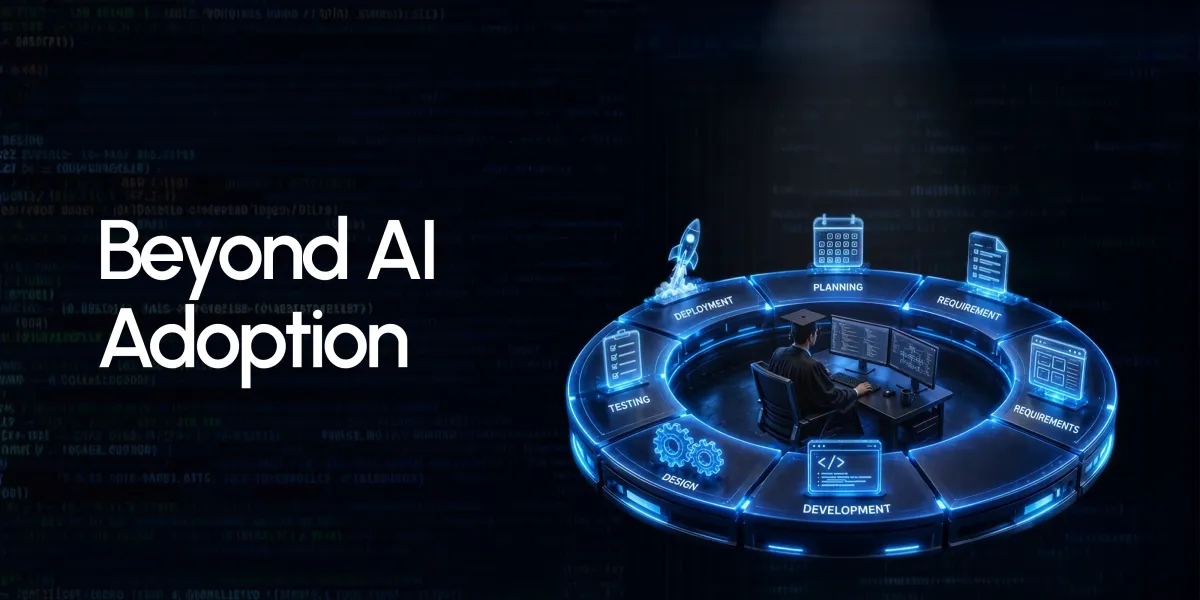
AI is no longer just changing software; it is changing how software is built.
Cloud computing transformed how software was delivered. Agile accelerated product development. DevOps shortened release cycles. Each shift redefined what it meant to build competitive software.
Today, another transformation is underway, one that is changing not just the products companies build, but the way those products are conceived, developed, and continuously improved.
Artificial intelligence is no longer confined to customer-facing features or productivity tools. It is becoming an integral part of the software delivery process itself. From planning and coding to testing, deployment, and operational insights, AI is reshaping how engineering teams collaborate and how software evolves over time.
This shift has given rise to AI-native delivery, an operating model where intelligence is embedded throughout the software development lifecycle rather than introduced as an afterthought.
For SaaS companies, this represents more than a technological upgrade. It signals a new source of competitive advantage.
As organizations make this transition, many are also rethinking how they build engineering teams, turning to partners like TeamScaler to access AI-native engineers who can integrate seamlessly into existing development environments and accelerate modern software delivery.
Organizations adopting AI-native delivery are reducing development friction, accelerating innovation, and responding to customer needs with a level of speed and adaptability that traditional delivery models struggle to match. Rather than scaling solely by increasing engineering capacity, they are creating systems where AI amplifies human expertise, enabling teams to achieve more with greater consistency.
Industry trends already reflect this momentum. According to Bessemer Venture Partners' State of the Cloud 2025, AI-native companies are reaching significant revenue milestones in a fraction of the time it took previous generations of SaaS businesses, highlighting how intelligent delivery models are reshaping growth trajectories.
This evolution raises an important question for engineering leaders: If AI is transforming how software is built, what does that mean for the future of SaaS delivery?
The answer lies not in adopting more AI tools, but in rethinking the entire software delivery model.In this article, we'll explore how AI-native SaaS is evolving beyond traditional development approaches, why AI-native delivery is becoming a strategic advantage, and what this means for organizations building the next generation of enterprise software.
From Traditional SaaS to AI-Native SaaS: Understanding the Evolution
Software has evolved through multiple waves over the past two decades. Understanding this progression helps explain why AI-native delivery represents much more than the next technology trend. It represents a shift in how software organizations operate.
Traditional SaaS
Traditional SaaS platforms transformed software by moving applications to the cloud and enabling subscription-based business models. Engineering teams relied on Agile methodologies, CI/CD pipelines, manual testing, and human-led development to deliver new features.
While this model significantly improved software delivery compared to on-premise systems, development remained largely dependent on manual engineering effort. Every feature, test case, deployment decision, and bug fix required substantial human involvement.
As customer expectations increased, these manual processes often became bottlenecks.
AI-Enabled SaaS
The next evolution introduced AI into existing SaaS products.
Organizations began integrating chatbots, recommendation engines, predictive analytics, copilots, and workflow automation into their applications. These capabilities enhanced customer experiences and improved operational efficiency.
However, AI remained an additional feature rather than the foundation of the product.
Engineering workflows continued to follow traditional development cycles. Development teams still depended on manual coding, manual testing, and conventional release management. AI improved parts of the product,but not the way software itself was delivered.
AI-Native SaaS
AI-native SaaS takes a fundamentally different approach.
Rather than viewing AI as a feature, AI-native organizations design both their products and delivery processes around intelligence from the outset. AI becomes embedded across engineering workflows, supporting product planning, code generation, quality assurance, infrastructure management, documentation, and continuous product optimization.
The distinction is subtle but significant.
An AI-enabled company asks:
"Where can AI improve our existing product?"
An AI-native company asks:
"How should we build software when AI becomes part of every stage of delivery?"
That difference reshapes not only the product but the entire operating model.
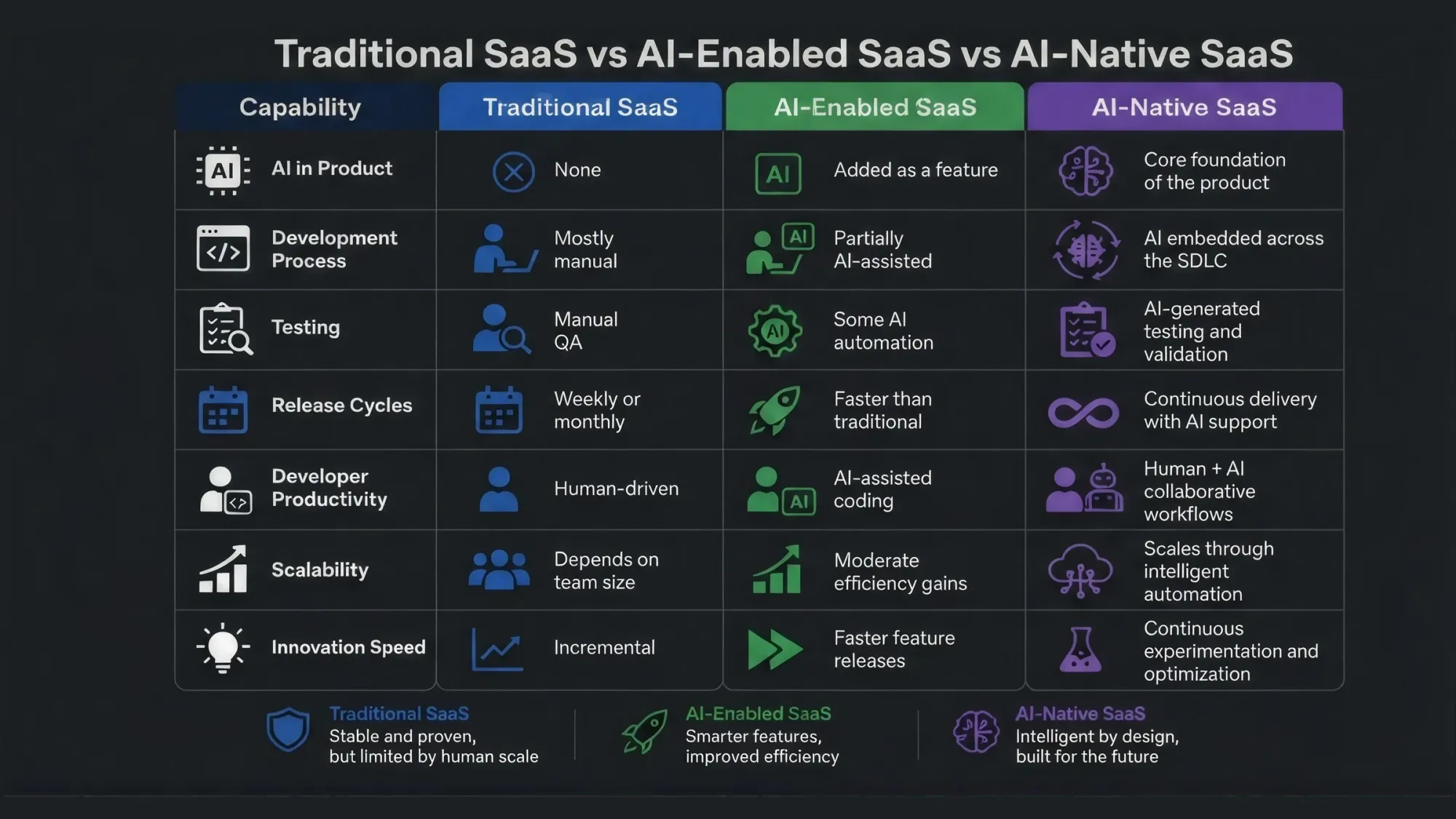
This progression illustrates why the conversation is shifting from AI adoption to AI-native delivery.
Competitive advantage is no longer determined solely by who introduces AI features first. Increasingly, it depends on who can build, improve, and scale software more intelligently.
AI-native delivery isn't defined by the tools a company uses. It's defined by how AI reshapes the entire software delivery model.
What Is AI-Native Delivery and Why Does It Matter?
For many organizations, adopting AI begins with individual productivity gains. Developers use AI assistants to generate code, product managers rely on AI for documentation, and support teams automate repetitive workflows. While these improvements create immediate value, they represent only the first step in a broader transformation.
AI-native delivery reimagines how software is delivered at an organizational level. where, AI-native delivery is a fundamentally different approach.
Rather than introducing AI at isolated stages of development, AI-native delivery embeds intelligence across the entire Software Development Lifecycle (SDLC). From product planning and architecture design to coding, testing, deployment, monitoring, and continuous optimization, AI becomes an active participant in how software is built, shipped, and improved.
This represents a shift from using AI as a productivity tool to building software with AI as a core operational capability.
According to the Digital.ai 18th State of Agile Report,organizations are increasingly using AI to improve software planning, engineering workflows, quality assurance, and release management,reflecting a broader shift toward AI-assisted software delivery.
Unlike traditional delivery models, where progress often depends on sequential handoffs between teams, AI-native delivery encourages continuous collaboration between engineers, AI systems, and operational data. This enables organizations to move beyond simply delivering software faster toward building software that evolves more intelligently over time.
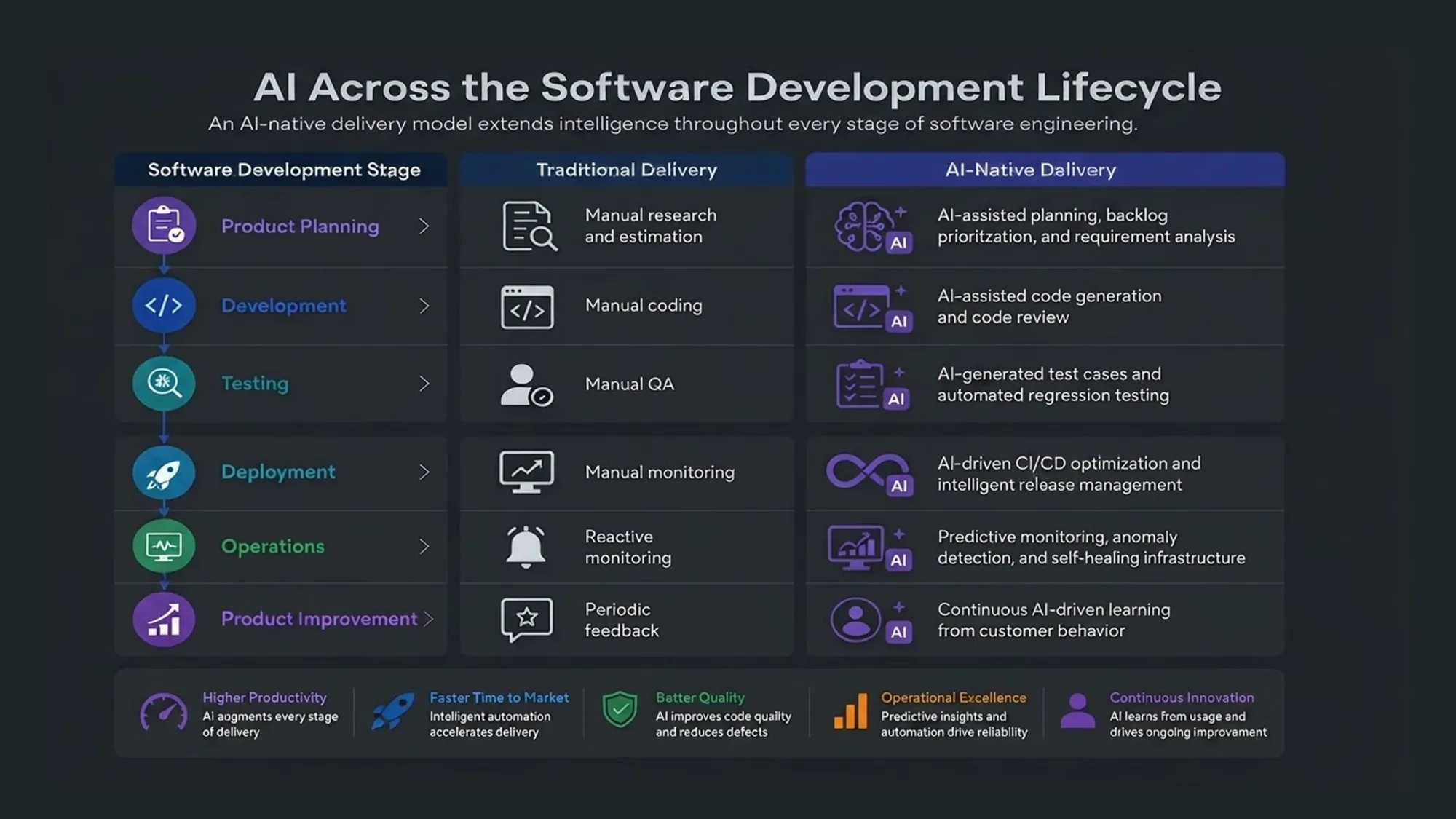
This continuous intelligence creates an environment where software evolves more rapidly, adapts to changing user needs, and reduces engineering friction at every stage.
At TeamScaler, this distinction is central to how AI-native engineering teams operate. As highlighted in TeamScaler's article, "How AI-Native Engineers Catch What AI Gets Wrong," mature engineering teams don't simply rely on AI-generated outputs.They use AI strategically while applying human judgment to validate, refine, and improve results. This combination of human expertise and AI augmentation is what creates sustainable engineering excellence.
The impact of this approach becomes even clearer when we examine the structural advantages that AI-native delivery creates for modern SaaS organizations.
1. AI Is Embedded into the Foundation, Not Added Later
Traditional SaaS platforms typically integrate AI after the product has already matured,integrating intelligent features into architectures that were originally designed without AI in mind. While this approach can improve functionality, it frequently leads to fragmented workflows, growing technical debt, and increased architectural complexity.
AI-native SaaS takes a fundamentally different approach.
Instead of layering AI onto an existing product, AI becomes part of the product's foundation from day one. Machine learning models, data pipelines, intelligent workflows, and automation are designed as core architectural components rather than optional enhancements.
This architectural mindset enables organizations to introduce new capabilities more efficiently without repeatedly redesigning their technology stack. It also creates greater flexibility for future innovation, allowing products to evolve alongside advances in AI and customer expectations.
As highlighted in Bessemer Venture Partners' State of the Cloud 2025, many AI-native companies have been able to scale rapidly because they build on modern, AI-first architectures rather than adapting legacy systems.
2. Faster Product Iteration Through Intelligent Automation
One of the biggest competitive advantages of AI-native delivery is speed.
In today's SaaS market, speed is no longer measured by how quickly teams write code,it's measured by how rapidly they can transform customer needs into production-ready solutions.
This is where AI-native delivery creates a measurable advantage.
Routine engineering activities including code generation, documentation, debugging, regression testing, security scanning, and deployment verification,can all be accelerated through intelligent automation. As repetitive work decreases, engineering teams gain more time to focus on product innovation, architectural improvements, and solving complex customer challenges.
The impact extends beyond engineering efficiency. Shorter development cycles enable organizations to validate ideas earlier, incorporate customer feedback faster, and release meaningful product improvements more frequently.
Research conducted by GitHub found that developers using GitHub Copilot completed coding tasks up to 55% faster, demonstrating how AI can significantly improve developer productivity when integrated into modern software development workflows.
The business impact is substantial.
Faster engineering cycles allow SaaS companies to respond to market demands before competitors, reducing time-to-market while increasing innovation velocity.
3. Higher Developer Productivity Without Proportionally Increasing Headcount
Historically, scaling a SaaS business often meant expanding engineering teams to keep pace with growing customer demands and increasingly complex products.
While hiring remains essential, continuously increasing headcount also introduces new challenges—from communication overhead and onboarding to coordination across distributed teams.
AI-native software development offers a different path.
By automating repetitive engineering tasks and augmenting decision-making throughout the software development lifecycle (SDLC), AI enables developers to spend less time on routine execution and more time designing scalable systems, improving customer experiences, and delivering strategic business value.
According to the Stack Overflow 2024 Developer Survey, more than 60% of professional developers now use AI tools in their daily work, with most reporting improvements in productivity and workflow efficiency.
The significance isn't that AI replaces developers—it doesn't. Instead, AI-native engineering empowers experienced teams to achieve greater output, maintain higher quality, and deliver more value without scaling resources at the same rate.
For growing SaaS companies, this creates a more sustainable model for long-term expansion.
4. Continuous Learning Instead of Static Software Releases
Traditional software delivery typically follows a predictable sequence:
Plan → Build → Test → Deploy → Gather Feedback
Although Agile and DevOps have shortened these cycles, they often remain structured around scheduled releases and periodic improvements.
AI-native delivery introduces a more dynamic approach.
Every customer interaction, support request, product usage metric, and operational signal becomes valuable input that can influence future product decisions. Rather than waiting for quarterly planning sessions or post-release reviews, AI continuously analyzes patterns, identifies emerging opportunities, and helps teams prioritize improvements based on real-world usage.
This creates products that evolve through continuous learning rather than incremental updates alone.
As organizations gain deeper visibility into customer behavior, they can make faster, evidence-based decisions that improve user experiences while reducing unnecessary development effort.
The result is a software delivery model where innovation becomes continuous instead of cyclical.
5. Operational Efficiency Becomes a Long-Term Competitive Advantage
Perhaps the most significant advantage of AI-native SaaS isn't simply faster development, it's the ability to build a more efficient and scalable engineering organization.
AI supports a wide range of operational activities, including infrastructure monitoring, incident detection, dependency management, documentation updates, deployment verification, and performance analysis. By reducing repetitive operational workloads, engineering teams can dedicate more attention to strategic initiatives that drive business growth.
The benefits extend across the entire organization.
AI-native delivery helps SaaS companies:
● Accelerate product innovation without compromising quality
● Reduce operational bottlenecks across engineering workflows
● Improve software reliability through intelligent monitoring
● Shorten release cycles while maintaining consistency
● Scale engineering capabilities without proportionally increasing operational costs
Over time, these efficiencies compound.
What begins as improvements in engineering productivity evolves into stronger organizational agility, better customer responsiveness, and a delivery model that becomes increasingly difficult for competitors to replicate.
As AI continues to reshape modern software development, AI-native delivery is emerging not just as a technology strategy, but as a structural advantage that supports sustainable growth and long-term competitiveness.
From AI Adoption to AI-Native Engineering
The structural advantages of AI-native delivery demonstrate that the future of SaaS isn't defined by AI adoption alone. The real differentiator lies in how organizations integrate AI into their engineering practices, delivery processes, and product development strategies
As AI-native delivery becomes the foundation of modern software development, organizations need more than AI tools,they need engineers who understand how to apply AI within real-world engineering environments.
Building AI-native software isn't about automating every task. It's about understanding where AI can accelerate development, where engineering expertise is indispensable, and how both can work together to build scalable, secure, and reliable software.
At TeamScaler, that's the mindset our engineers bring from day one.
When a TeamScaler engineer joins your team, they don't begin by introducing new AI workflows or changing the way your teams operate. They first take the time to understand your product architecture, codebase, deployment pipelines, engineering practices, and the maturity of your existing tooling. Only then do they identify where AI can meaningfully improve development velocity, software quality, and long-term maintainability without disrupting the workflows that already work.
They don't impose a process. They observe, adapt, and then contribute.
That approach isn't just a soft skill,it's an engineering discipline. It's what enables TeamScaler engineers to integrate seamlessly with your team, delivering value from the inside rather than operating as an external resource.
As AI-native SaaS continues to reshape enterprise software, the organizations that gain the greatest competitive advantage won't simply be those with access to AI technologies. They'll be the ones with engineering teams that know how to apply AI thoughtfully, responsibly, and at scale.
Building AI-native software requires more than adopting AI tools, it requires engineers who know how to apply them effectively. TeamScaler helps SaaS companies extend their engineering teams with pre-vetted AI-native engineers, available in as little as 72 hours, who integrate seamlessly into existing workflows. The result is faster software delivery, reduced hiring overhead, and a cost-effective way to scale engineering capacity without compromising quality.
Ready to accelerate your AI-native journey? Connect with TeamScaler